2011 Summer Field School
Faculty:
Associate Professor of
Archaeology
Department of Social Sciences
Office Location: 213 Academic
Offices
Office Phone: 906.487.2359
Email
Assistant Professor of
Archaeology
Department of Social Sciences
Office Location: 211 Academic
Offices
Office Phone: 906.487.1476
Email
Cliff Mine Survey Project :

Stack and chimney in the woods at the Cliff Mine Site during the winter snow in 2010.
Join the Industrial Archaeologists from Michigan Technological University, documenting an historic copper mine in the heart of the Keweenaw Peninsula. The Keweenaw is famous as one of the few places on earth where humans found abundant formations of "native" copper, ranging in size from pebbles to record-breaking boulders of pure metal. This will be the second season studying the ruins of the Cliff Mine and Clifton (1845-c.1870), the region's first profitable copper mine. The site sits atop and below the 200-foot greenstone bluff that runs along the spine of the Keweenaw Peninsula, about 30 miles northeast of Houghton, Michigan. We will be reconstructing the evolution of the industrial process using clues left by workers as they built, worked, and reworked the site's shafts, mill, engine house, kilns, stacks, shops, houses, and offices.
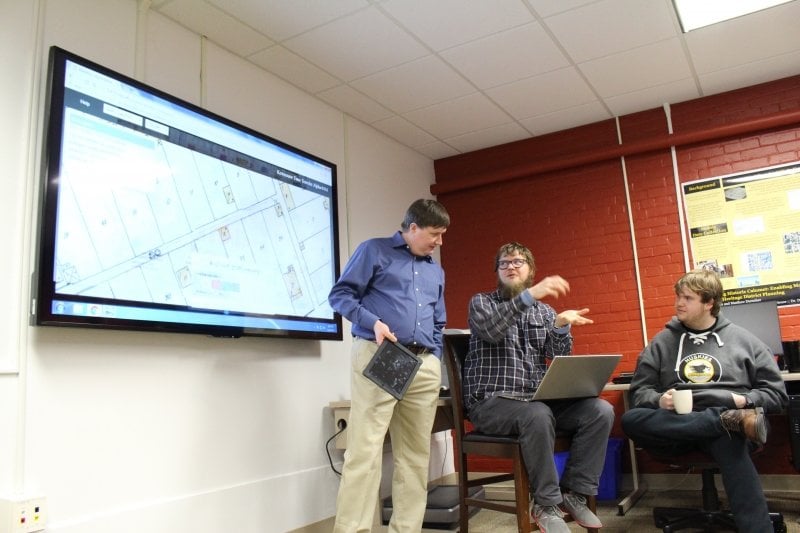
During the 2010 season, the research team completed a site survey, gathering data using a Topcon Total Station and Digital Collector and handheld Trimble GeoExplorer GPS units, supplemented with LiDAR surveys of the ruined architecture. During the past year, researchers built this data into a GIS framework that also included historic maps and photographs, aerial photographs, and multispectral satellite imagery. Discussion, images, and films of the research were posted on the project blog:
http://cliffmine.wordpress.com
The 2011 field school participants will continue research in these areas. Project members should anticipate learning and working in the following areas:
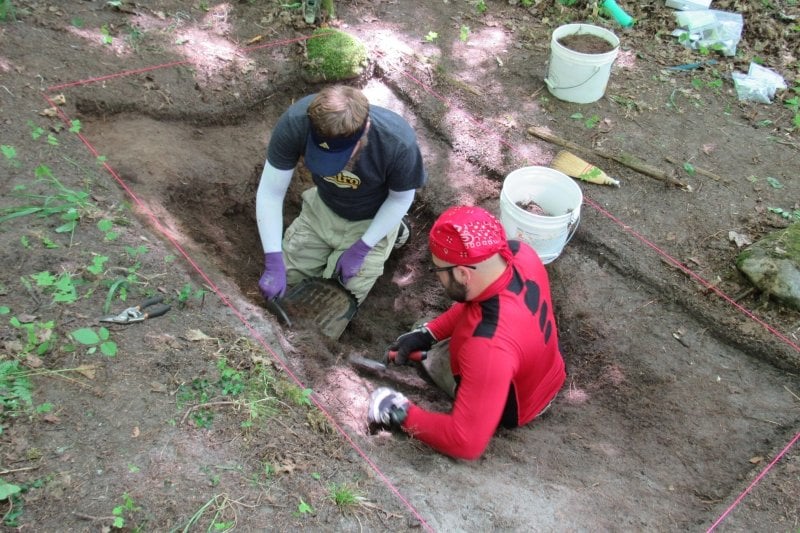
1. Conducting excavations in the Stamp Mill Complex, investigating work areas and processes in this well preserved and early example of a mill. In addition, student researchers will use excavation and shovel test probes to better define the extent, functions, and state of preservation of other buildings throughout the mine and community, including in areas near the Avery Shaft.
2. Research teams will ground-truth the CliffMAP GIS predictions of landscape features and transportation infrastructure. They will base testing on multispectral satellite images and historic aerial photographs. Students will learn multiple documentation techniques, such as digital and optical mapping, use of ground-based, aerial, and satellite-based remote sensing in survey- including LiDAR and perhaps ROV aerial photogrammetry, Underwater Acoustic and Sonar survey, measured drawings, photography, and artifact analysis.
3. Teams will continue to document the settlement of Clifton, including more detailed mapping of the town and exploratory excavations to assess research potential in this historic community. The research focus includes attention to the food supply network, so students can expect to learn archaeobotanical sampling strategies as part of efforts to locate and understand the garden plots.
4. Michigan Tech's Industrial Archaeology research teams will be collaborating with the the Nautical Archaeology Society's International Field School at Northwest Michigan College in Traverse City, Michigan. The NAS Divers and students will join us to begin exploratory acoustic and sonar mapping of the Cliff dock at Eagle River and other maritime industrial features.
All participants in the Cliff Mine Archaeology Project become public archaeologists, collaborating with community members and other guests to the site. Along with fieldwork, there will be field trips, lectures, and discussions devoted to the history and technology of early copper mining in the Keweenaw and the communities and landscapes it produced. These public lectures are further supplemented by public days at the site where all research team members show site visitors around the Cliff, it's community, and landscape, while discussing connections between the story of copper and the Keweenaw's communities today.

Sean Gohman talks with guests and community stakeholders about the Cliff Mine's Stamp Mill, during a public event in 2010.
The course is co-taught by Timothy Scarlett and Samuel Sweitz. Both Drs. Scarlett and Sweitz are published anthropologists and archaeologists with experience in North American hardrock mining history and archaeology, in addition to the industrial and historical archaeology of the United States, Mexico, and the Caribbean.
Students can anticipate field trips to local mining sites, the Copper Country Archives, the Keweenaw County Historical Society museum, and perhaps a curator's introduction to the collection at the Seaman Mineral Museum. We also anticipate a number of guest lectures by noted scholars, including:
Dr. Larry Lankton: professor, historian of technology, and author of several books and articles about the Copper Country, including Hollowed Ground: Copper Mining and Community Building on Lake Superior, 1840s -- 1990s (Wayne State University Press, 2010); Cradle to Grave: Live, Work, and Death at the Lake Superior Copper Mines (Oxford University Press, 1991); and Beyond the Boundaries: Life and Landscape at the Lake Superior Copper Mines, 1840-1875 (Oxford University Press, 1997).
Dr. Susan Martin: anthropologist, archaeologist, and author of Wonderful Power: The Story of Ancient Copper Working in the Lake Superior Basin (Wayne State University Press, 1999). Dr. Martin is an Associate Professor of Anthropology at Michigan Tech.
Dr. Michael Falkowski: Remote sensing and Resource Management specialist with expertise in high spatial resolution remote sensing, including LiDAR. Dr. Falkowski is an assistant professor in Michigan Tech's School of Forest Resources and Environmental Science.
Dr. Patrick Martin: professor, industrial archaeologist, and current president of The International Committee for the Conservation of the Industrial Heritage (TICCIH), the international body that advises ICOMOS regarding Industrial Heritage issues.
Dr. William Rose: author, professor, geologist, and volcanologist with expertise in the geology of the Keweenaw Rift. Dr. Rose teaches in Michigan Tech's Department of Geological and Mining Engineering and Sciences.
Mr. Kenneth Vrana: author, underwater archaeologist, and maritime resources management specialist. Ken is the director of Michigan Technological University's Isle Royal Institute and the President of the Center for Underwater and Maritime Resource Management in Laingsburg, Michigan.
Dr. Mark W. Holley: underwater archaeologist, operational/scientific diver, and Instructor of Archaeology and Anthropology at Northwestern Michigan College. Mark is a Fellow of both the Royal Archaeological Institute and the Society of Antiquaries of Scotland. He is Chief Archaeologist of the Grand Traverse Bay Underwater Preserve.
Mr. Sean Gohman: Industrial Archaeologist, author, research blogger, and creator of CliffMap. Sean Gohman is studying for his PhD in Industrial Heritage and Archaeology at Michigan Tech. His public lectures are popular throughout the Copper Country.
Course Details:
Students will live in Houghton. Michigan Tech will help guest students to find accommodations in town for during the field school. Project participants are encouraged to explore the Keweenaw during their time off, and many will choose to bring outdoor recreation gear for mountain biking, rock climbing, hiking, backpacking, and road biking, and the many water sport opportunities provided by Lake Superior. Students are also encouraged to attend the 2011 Annual Meeting of the Society for Industrial Archaeology in Seattle, Washington.
This is an equal opportunity course, and students with disabilities or special needs should contact Dr. Scarlett to discuss accommodations during the registration process.

To register for the field school, please download
an application form here. If you
are an MTU student, a student from another
American university, or an international
student, please follow the rest of the instructions on this
page.

MTU
Students:
MTU undergraduate students can use the field school to fulfill up to six credits for several general education degree requirements: HASS Creative Endeavor, FES Environmental Electives, Performance Activities, SSS Anthrop/Archaeology Elect, and World Cultures. Please check with your advisor before enrolling to be sure the course works.
Register for the Archaeology
Field School on Banner WebReg just like a regular summer course.
Download an application form and fill it out. You can repeat credits for SS 3210/5700, so you can take this class again for credit if you have already completed a field school. Contact
Dr. Scarlett for details.

Students
from Other Universities:
First, download
an application form and send it to the IA program. Then students
should visit the Registrar at the home university and request a
"Guest Student Application Form." Using your own
university's form streamlines your credit transfer process.
If your university does not have such a form, access the web address
below and print out the State of Michigan's Guest Student Registration
Form.
https://www.admin.mtu.edu/em/students/records/guest.php
Type in your information.
You are applying to Michigan Technological University (Form item
#11). The form asks if you are planning to take either SS
3210, Track A (undergraduate) or SS 5700, Track A (Graduate).
These classes go into Box #15 on the form. The dates and cost
estimates are above. Track A is the Cliff Mine Survey. You may enroll in whatever number of credit hours
your institution requires. For example, some universities
require their students to complete 4 credit hours of field school
training. You should enroll for the number of credits appropriate
to your home department or university's requirements.
You might need to take
the form to your university's registrar and they will certify your
application and forward the form to MTU's admissions office.
You should ask your registrar. They will probably ask you
to include a $30 application fee. MTU's admissions office
will stamp the form and send it along to our Student Records and
Administration office. Direct questions about registering
to:
Michigan Technological
University
Office of Student Records and Registration
1400 Townsend Dr, Houghton, Michigan 49931-1295
Email: stuosrr@mtu.edu
Phone: (906) 487-2319
Fax: (906) 487-3343
Someone from MTU will
let us know you are registered, but if we have your application
form but your name does not appear on our registration lists, we'll
know there's a problem.

International Students:
International students
could participate on a tourist visa, since the class only lasts
six weeks. Send us a completed application,
by email or fax would be best (906-487-2468). You should contact
your home university's international studies coordinator or Thy Yang at MTU's International Programs and Services department:
http://www.ips.mtu.edu/Office_Info/index.htm
Michigan Tech has a number of international
cooperative and exchange agreements that can facilitate guest students
from around the world. We encourage prospective field school
students to contact the IPS office for advice.
|